In order to fulfil this purpose, we advocate that RE needs to provide a balance between three disciplines. These are:
- Theology: This is about believing. It looks at where beliefs come from, how they have changed over time, how they are applied differently in different contexts and how they relate to each other.
- Philosophy: This is about thinking. It is about finding out how and whether things make sense. It deals with questions of morality and ethics. It takes seriously the nature of reality, knowledge and existence.
- Human/Social Sciences: This is about living. It explores the diverse ways in which people practise their beliefs. It engages with the impact of beliefs on individuals, communities and societies.
An animation explaining these three disciplines is available to view here:
The aims of Religious Education in Church schools are:
- To enable pupils to know about and understand Christianity as a living faith that influences the lives of people worldwide and as the religion that has most shaped British culture and heritage.
- To enable pupils to know and understand about other major world religions and world views, their impact on society, culture and the wider world, enabling pupils to express ideas and insights.
- To contribute to the development of pupils’ own spiritual/philosophical convictions, exploring and enriching their own beliefs and values.
(National Society for Education RE Statement of Entitlement 2026)
Helpful documents
National Society for Education RE statement of Entitlement 2026 and Norfolk Agreed Syllabus 2019
We have called this thinking through believing. It is about asking questions that believers would ask. It requires pupils to think like theologians, or to look through a theological lens at concepts.
We have called this thinking through thinking. It is about asking questions that thinkers would ask. It requires pupils to think like philosophers, or to look through a philosophical lens at concepts.
We have called this thinking through living. It is about asking questions that people who study lived reality or phenomena would ask. It requires pupils to think like human and social scientists, or to look through a human/social science lens at concepts.For a summary of this approach see: https://www.youtube.com/watch?v=6NTW2bsFTLY
In broad terms the following principles have been applied to each discipline in terms of what it means to become more religiously literate:
- Extending knowledge and understanding from the concrete and familiar to the abstract and complex
- Moving from simple ideas and beliefs/concepts to making connections between them and placing these within a bigger picture or meta-narrative
- Demonstrating increasing layers of interpretation of religion, religions, beliefs and worldviews through engagement with a broadening and increasingly complex range of information
- Showing an increasing ability to critically question and form coherent, logical arguments, including increasing recognition of divergences of opinion about and the controversial nature of religion and belief
- Expressing a broadening understanding of diversity in terms of the nature of religion, religions and worldviews
How these age-related expectations were developed
Teachers trialed a draft form of the age-related expectations for 6-9 months in 2018. During this time teachers used the expectations to plan as well as assess pupils progress. In March and June 2018, a group of teachers shared their work with one another in order to exemplify standards and make minor changes to the expectations. In addition, a survey was sent to all 30 trial schools and academies to gage initial feedback on using the new assessment process. The age-related expectations have been used by all Diocese of Norwich schools and academies from September 2018.
Examples for each disciplinary field
Here is an example strand of expectations for theology:

Here is an example strand for philosophy:

Here is an example strand for human/social science:
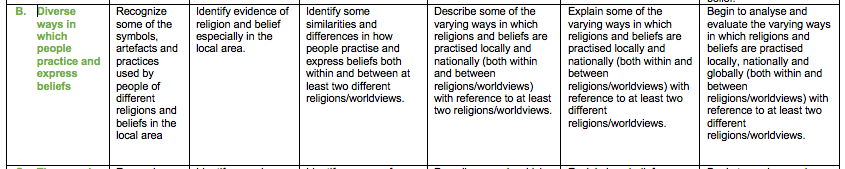
There are 10 age related expectations for each Year Group KS1-3.
How to use the age-related expectations
The age-related expectations are designed to underpin planning as well as assessment. Further details about this are explained in the professional development resource which you will receive when you register. It is worth noting that using these expectations can have an impact on how you design your curriculum through a multi-disciplinary approach.How to register to use these age-related expectations
We are a Diocese of Norwich VA or VC school:
Please contact Jodie Ballard, PA to the Director of Education, via jodie.ballard@dioceseofnorwich.org You will be required to declare that at least one person in your school will complete the online training which will be released to you once you have registered. This training takes about one hour to complete. A password to access the training and resources will be sent to you.
Religious Education Networks
RE Local Leaders in Education RE Local Leaders in Education is a group of teachers that meets termly from primary, secondary, church, community and academy contexts to share good practice, listen to guest speakers and visit places of interest linked to RE. For more information please contact Fiona Greening via fiona.greening@dioceseofnorwich.org.
RE Ambassadors (DNEAT) RE Ambassadors (DNEAT) is a group of RE Leads who work within DNEAT and meet online each term to undertake practical action research projects to support the development of high-quality RE. For more information contact DNEAT at www.dneat.org/contact/contact-our-central-team/
Primary Subject Leader Support Meetings – RE Primary Subject Leader Support Meetings – RE is a group who meet online each term to share good ideas and resources, support each other in teaching or leading RE in school and have built up a Padlet of valuable resources linked to RE. For more information contact: landitraining@norfolk.gov.uk or visit https://s4s.norfolk.gov.uk/Event/203391
Other useful RE Networks and organisations:
- RE Hubs – is a one stop website for training, news, visitors, speakers, support for ECTS, local Re groups directory and much more.
- NATRE – is the National Association for Teachers of RE.
- RE Council – is the advisory body for RE in England and Wales.
Contact us
For advice on further RE resources please contact us on 01603 882357.
Home