- Parish Support Team
- PCC Support
- Finance Support
- Generous Giving
- Church Buildings and Development
- Communications
- Property and Glebe
- Home
- Parish Support
- Church Buildings and Development
- Church Buildings Guidance and Support
Church Buildings Guidance and Support
Conservation
- Conservation management plan
- Conservation of books and manuscripts
- Conservation of church plate
- Conservation of easel paintings
- Conservation of metalwork
- Conservation of monumental brasses
- Conservation of monuments
- Conservation of rood screens
- Conservation of textiles
- Conservation of timberwork
- Conservation of turret clocks
- Conservation of wall paintings
- Conservation reports
- Managing conservation projects
- Post conservation treatment reports
Waterless Toilets
Other
- Alternative roofing materials to lead
- Anti-social behaviour in churches and churchyards
- Archaeology Guidance
- Audio visual equipment in church buildings
- Automatic door locks guidance
- Bats in churches – undertaking work
- Construction design and management regulations
- Deed of gift template
- Deposit of books and documents
- Disaster management plan
- Display cases
- Disposals and loans
- Electrical wiring installations in churches
- Equal access to church buildings
- Example risk assessment form
- Energy efficiency and historic buildings – solar electric
- Flags military colours and historic banners
- Floodlighting
- Fonts
- Glass screens
- Historic floors
- Legal options for complementary use of church buildings
- Lighting
- Maintenance calendar
- New art for churches
- New glass for your church
- Pew self-assessment form
- Protecting your church’s treasures
- Quinquennial inspections
- Rainwater goods and drainage
- Reordering – alterations and extensions
- Roofs
- Ruined churches
- Seating
- WCs and Kitchens
- Fire Safety for Traditional Church Buildings
- Church logbook template
- Church property
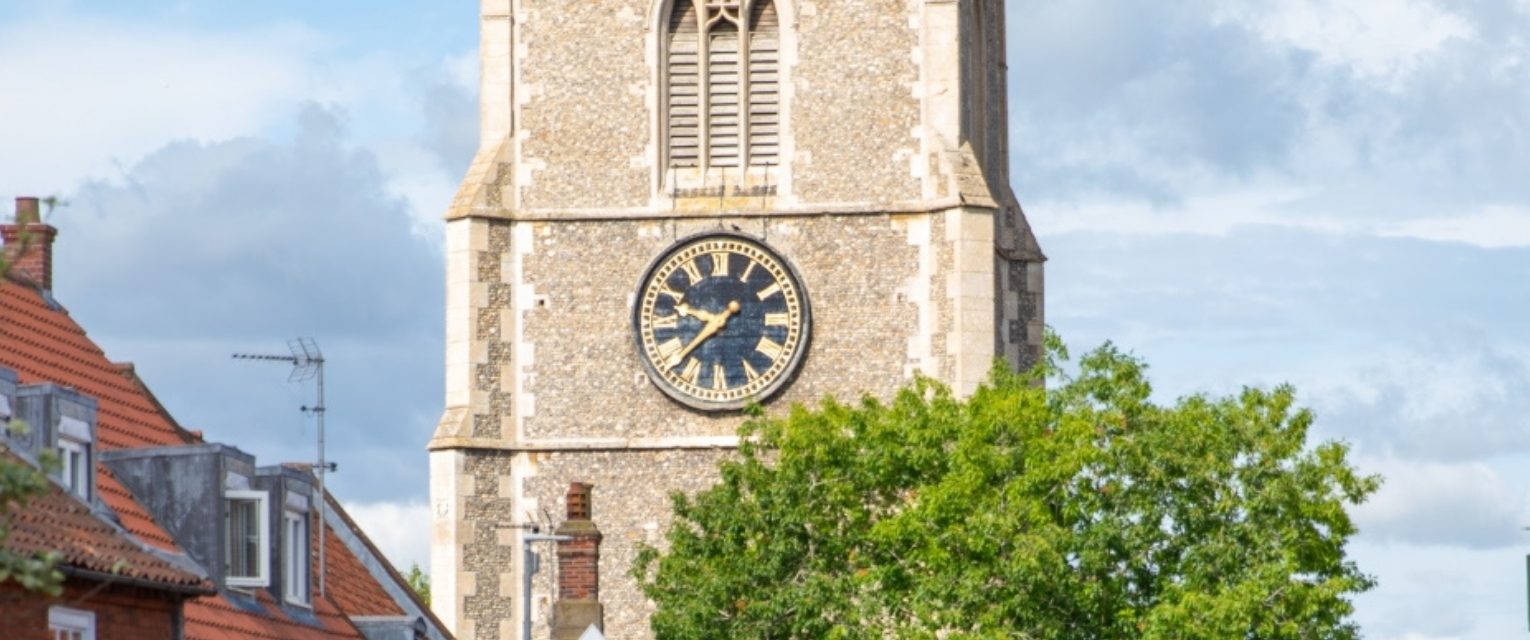
Eight years ago, St Nicholas Church in the village of Twyford was fundraising in order to finance some increasingly urgent repairs. As for many historic church buildings, its roof was among the main causes for concern. Grant applications were made and a relatively conventional restoration project was in the offing.
Unfortunately, a straightforward solution was not on the cards. The needs of this Grade II* listed building in the Heart of Norfolk benefice became altogether more complex when, in February 2021, a large tree in the churchyard was uprooted and crashed down onto the tower – damaging the bellcote.
Fast forward to February 2025, and much of the structure is now enrobed by scaffolding as the painstaking work to restore St Nicholas’ tower to its former glory – and structural integrity – is under way.
Many of the arrangements for this project have been supported by the Diocese of Norwich Care and Development of Church Buildings team.
The team helped secure funding from the Norfolk Churches Trust, a charity which specialises in offering help to the hundreds of centuries-old places of worship dotted throughout the county.
Arrangements were also made by the Care and Development of Church Buildings team for the work to be carried out by Spire, a construction and architectural consultancy which specialises in supporting churches and affiliated organisations.
Discussing ongoing backing for St Nicholas’ and many other churches like it across the diocese, Linda Joel, Secretary of the Norfolk Churches Trust, said:
“We were approached about eight years ago for a grant to help with the repairs, which we offered. The parish had been busy fundraising to build that, but in the meantime, a very large tree came down three years ago and caused huge amount of damage. We feel really passionate about helping to restore and keep these village churches open for people to visit, and for continued use within the villages. The Trust definitely believes that collaboration is the way to go. The demands of money is to keep the church going is huge. And it’s fantastic that we have such a wide range of expertise in different organisations; with the Diocese, with the trust and other charities. So I think it’s really important we work really hard together so that we can offer a wider support.”
Does your church need support on a repair, restoration or maintenance project?
A Project Support Pack guide can be viewed and downloaded here, providing answers to many frequently asked questions.
Alternatively, you can get in contact directly with the Care and Development of Church Buildings team.
Churchwardens and many others do a huge amount of work to keep our beautiful churches well maintained. These resources are intended to support those already doing this valuable work and inform any who might be new to a volunteering role in this area. Documenting existing arrangements can also help with delegating tasks and spreading the load of this important work.
Regular maintenance and minor repairs can prevent larger more costly problems from developing, make a building feel welcoming, and can be a great way to engage your community. Even if you feel like your church building has more significant problems, keeping on top of regular maintenance can still slow the rate of deterioration giving you time to plan a project for more extensive repair work.
In order to spot small issues before they turn in to bigger problems it is a really good idea to do a regular building inspection, or document this if it is something you already do. This is a simple walk round inspection looking out for issues such as blocked drains, plants growing in or around walls or damp patches inside. It can be done completely from ground level, using binoculars to look at higher levels of the building. You could even make a habit of doing this with a friend after a service every so often. The following link gives a template and checklist of what to look out for when carrying out a building inspection.
Click here for a series of short videos produced by the Society for the Protection of Ancient Buildings (SPAB) and the National Churches Trust that guide volunteers through each aspect of a regular building/maintenance check.
Both these resources were produced as part of the Taylor Review Pilot Project managed by Historic England.
Having a simple written or photographic record as a result of these inspections can help monitor change in the building and inform the work of your church architect when it comes to your regular detailed Quinquennial Inspection.
The Taylor Review Pilot Project also developed a more comprehensive maintenance plan template which can be downloaded here.
Maintenance Checklist for places of worship.
These plans can then be used by volunteers or by maintenance contractors. You can identify which jobs can safely be done by who, and delegate tasks to spread the load.
If you would like help adapting one of these templates or producing a maintenance plan please contact Frances Jackson. Your plan will draw on information from your QIR and your church architect may also need to be consulted when planning maintenance.
- A Stitch in Time – why maintenance and small repairs really matter – handout from a training session which formed part of the Taylor Review Pilot
- Church Care Calendar of Care from the Church Buildings Council
- The Church Buildings Council Advice and Guidance for church buildings
- The SPAB have many good resources relating to the care of historic buildings
- Historic England – Maintenance and Repair of Places of Worship
- Ensure that gates, boundary walls, hedges and noticeboards are well maintained, as these are often the first things visitors see as they approach the church.
- Place a sign outside your building indicating that visitors are welcome and the church is open.
- If you are able to provide disabled access, are the instructions for assisted access clearly displayed? Click here to print out a sign indicating a portable ramp is available.
- If you have toilets, are they open, clean, tidy and available for use? It is really annoying when toilets are advertised, and which can be seen when visiting the building, but are inaccessible.
- Is your church clean and tidy? If not this can leave a lasting impression and make visitors feel that the church is being neglected, even if it isn’t.
- Check that your notice board isn’t faded or showing out of date notices. Are banners and hangings up-to-date, and in good condition?
- Keep dog bowls clean and freshly refilled. If this is difficult, perhaps have an empty bowl available that can be filled as and when needed.
- It is important to have good guides and interpretative material on offer, either in paper format or using modern technology.
- Consider developing a free simple, single sheet with basic interpretation of features of the church for those who are not familiar with the structures and layout. Have another more detailed guide with the history, points of interest, events, or important local people particularly associated with your church.
- Consider having a designated prayer area with invitations to pray or with candles to aid reflection and meditation. If you do provide candles, please make sure there is a means of lighting them.
- If you have features within your churchyard that you would like visitors to see, ensure that the paths leading to them are cut regularly. Check that any benches or seats are kept well maintained, making them pleasant to sit on and quietly reflect.
- Consider how you ask for donations, and when. The visitor experience is enhanced by first seeing a welcome sign and guides on entry but is diminished by first seeing a sign saying how much it costs to keep the church open. Consider having a donation box notice on the way out.
All churches are listed on the Exploring Norfolk Churches website which includes information such as opening times, accessibility and parking. Check that the information on your church is up-to-date and email Eliza Greenwell on eliza.greenwell@dioceseofnorwich.org if any changes need to be made.
Memorial tablets in churches: DAC Guidance
The DAC frequently receives applications for the installation of memorial tablets in churches. All such applications are considered by the DAC on a case-by-case basis. Such tablets become a permanent part of the church fabric: it is important that they are appropriate in form and that there is not an excessive proliferation of tablets.
In a recent (2020) judgment in the Oxford Consistory Court, it was commented that “There is a consistent line of authority in English ecclesiastical jurisprudence to the effect that the grant of faculties for the erection of memorials should be ‘sparingly exercised’”. Memorials may be expected to remain in place for a considerable time and the space for them in a church is finite and has the potential to serve many generations.
The Chancellor will therefore apply the test of ‘exceptionality’: there will need to be a compelling reason for allowing a memorial tablet. For example, the person commemorated should have made an especially significant contribution to the life and work of the church in question, or to the community, or to have been an individual of national significance. The DAC is aware that the Chancellor will need to be satisfied that sufficient time has elapsed between the death of the person commemorated and the application for a commemorative tablet to allow for a measured reflection on the life and contribution to the church and community of the person concerned.
The Diocesan Advisory Committee has decided that applications for plaques in churches will not be approved unless the person to be commemorated had been deceased for at least five years. It is not acceptable to commemorate a living person, such as the spouse of the deceased, on the tablet. The wording of the tablet should be such as to make clear to a visitor to the church from outside the area why this individual has been considered worthy of commemoration.
It should also be remembered that where a family or a congregation wishes to commemorate the life of someone associated with a particular church, this can also sometimes be achieved by means other than a commemorative tablet, such as the gift of a prayer ‘kneeler’ or some other item useful to the particular church.
Memorial tablets always require a faculty from the Chancellor. The petition will need to make the case for the “exceptionality’ of the monument. Applications should be accompanied by life-size or scale drawings of the proposed tablet.
They should:
- Show the proposed location of the memorial in the church. There should be photographs of the proposed site showing its relationship to other features in the church
- State clearly the material to be used
- Indicate the edge mouldings, font used and the depth and style of any incised lettering
- State whether the lettering is to be hand or machine-cut.
- Specify how the tablet will be fixed to the wall
- Include the wording of the inscription.
Materials and design:
- Materials such as slate, wood, or English stones are preferred. If metal is used, bronze is preferred to brass as it does not require polishing.
- A memorial tablet becomes a permanent architectural feature of the church and therefore the material chosen, the quality of design, the skill of the lettering, and the felicity of the inscription all contribute to a memorial that will embellish and enhance the interior of a church. The design must therefore be of high quality
- The wording should be concise but informative so that the distinction of the person commemorated is clear, and the appropriateness of the memorial in the particular church is obvious
- All fixings should be stainless steel, inserted with minimal disturbance to the fabric. Tablets/memorials should be mounted on the face of the plaster unless it is guaranteed that no wall paintings exist. If the tablet is to be sunk into the plaster it should be protected from damp in the masonry behind, and a certificate from an architect or conservator provided saying that they have examined the wall, and no decorations or hidden wall paintings exist beneath
- Check with your church architect or surveyor that the plaque will cause no damage to the ancient fabric. Confirmation of this should be included in the petition for a Faculty.
After installation, the tablet should become the property of the church, rather than the person who presented or commissioned it. It should be recorded as such in the church terrier. Legal ownership will therefore pass to successive incumbents.
The Chancellor has made it clear that the fact a commemorative tablet has already been commissioned or created before seeking a faculty will not influence the decision as to whether or not permission will be granted.
Grant funding often plays an important role in fund raising for a church repair or facilities project, but how do you go about searching for sources of grant funding and making sure you are ready to apply? Here are some basic tips to get you started.
Are you ready?Often it can be tempting to start applying for grants as soon as you have a project in mind or know some work needs doing. In a few cases, where there is a simple small project, a clear need and a reasonably sure source of funding this might be ok. But here are some things you should normally consider before applying to funders to check you are ready:
- Have you considered how much money you can raise in total, from grant funders or other sources? Most grant funders will only fund a small percentage of your overall project cost, so an application to a single grant funder will need to be part of a funding strategy or budget that shows what your other sources of funding might be. Assessing how much you might be able to raise will also help you define the scale of your project before spending money on specifications, surveys etc. You will need to look carefully at the grants that might be available for your project paying close attention to the eligibility criteria, requirements for match funding, deadlines and so on. The following templates may be useful for prioritising grant funders, and keeping track of fundraising (click for links).
- Do you have an up to date Quinquennial Inspection Report, or alternatively a supplementary or interim report from your architect? Some grant funders will require this to assess the need for the work, so check with the individual funder or your architect.
- Some works require additional surveys or investigations, such as asbestos surveys, bat or other wildlife surveys. If required, the surveys may need to be completed before applying for grants and be up to date. You may also need specific licenses/permits to carry out work, particularly in the case of bats.
- Do you have the necessary permissions such as a faculty or planning permission (if required)? See the Permissions and how to apply area of our website
- At the time you apply, most grant funders will need an up to date quote for the work, and some will require you to have gone to tender and sought three quotes for the work. Your architect can normally guide you through this tender process.
- Do you have support from the community, and as much evidence for this as possible? Evidence might include details of past events and activities, referring to social media or other places where events are advertised, letters of support, the results of a survey or comments in a visitors book.
The Church Building Ambassadors are experienced volunteers who can help churches with a whole range of tasks and queries. The network of Church Building Ambassadors has been built up of people with diverse skills and experience, very familiar with the challenges the churches are facing and willing to help.
Among the tasks the Ambassadors have been involved in are:
- Community involvement and outreach
- Grant funding applications/identifying sources and assisting with writing
- Welcome and tourism
- Online Faculty applications/preparing relevant documents for DAC
- Maintenance and understanding QIRs
- Establishment of Friends Groups
- Producing a business plan/managing funds
- Identifying historic and architectural value of buildings/producing statements of need and significance
- Security
An Ambassador would be happy to give you a one-off advice or guide you through a project or a task. Ambassadors, however, are not professional advisors but should be seen instead as experienced colleagues and critical friends.
If you would like further information or to be put in touch with an ambassador, please contact Frances Jackson – Historic Church Buildings Support Officer.
Diocese of Norwich Project Support Pack
A Project Support Pack guide can be viewed and downloaded here providing answers to many frequently asked questions.
How to fund the things you wish to do
A useful short video produced by the Diocese of Lincoln about applying for grant funding.
How to plan for a major church capital appeal
Understanding what steps to take before you even start fundraising; what income streams you will need to engage with; what systems and resources you will need to put in place so your appeal is successful.